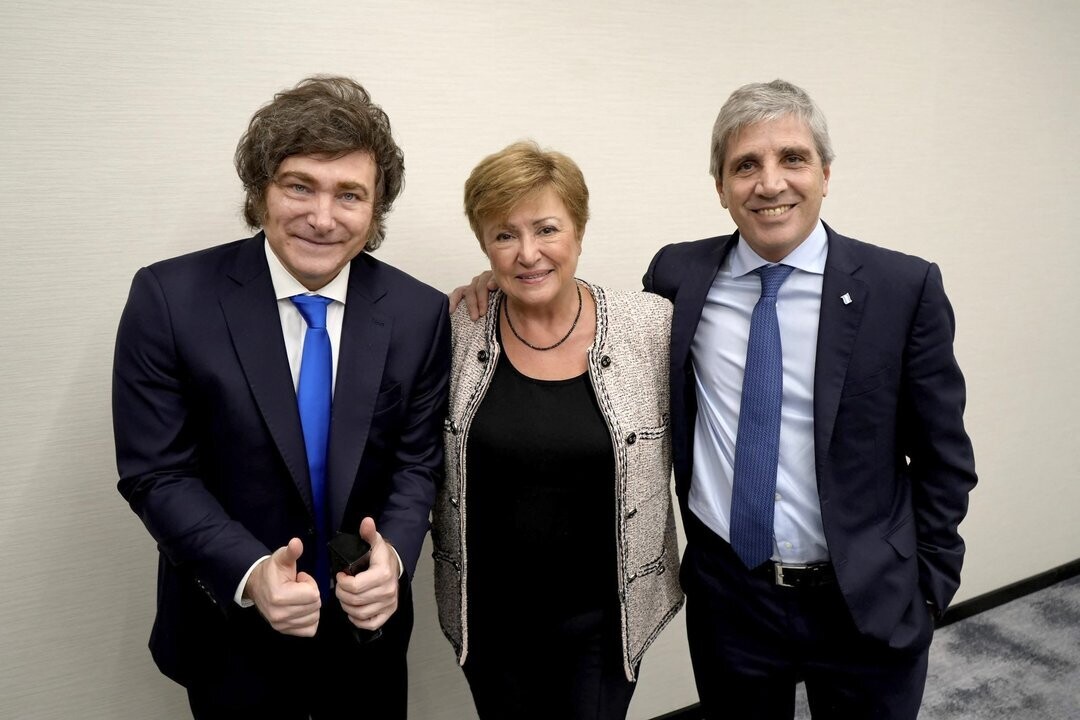
The International Monetary Fund (IMF) will arrive in Argentina during February to carry out the economic program review, while the Government must face payment deadlines with this organization. The IMF comes to the country to develop the second review of the $20 billion economic agreement, signed last April. As this is an interest payment, it cannot be postponed until the end of February. This is the second payment the Executive Branch will have to face, after having met one of its obligations for $4.2 billion at the beginning of January. The IMF's visit takes place in a context where attention is focused on the accumulation of reserves by the Central Bank (BCRA). After having agreed on the first one last year, the organization led by Kristalina Georgieva arrives in the country, after postponing that audit for several months. In response to a query from the Argentine News Agency, sources from the Ministry of Economy did not specify the day the mission will arrive in the country, although they confirmed it will take place during the second month. In parallel, the Government faces maturities with the Fund for $840 million next week. From the international organization, they recognize that with the start of the “phase 4” of the monetary program, the pace of accumulation “began at an accelerated rate, which is very good.” The new scheme was also recognized by Georgieva herself after meeting with Luis Caputo at the World Economic Forum in Davos. Kristalina Georgieva and Luis Caputo, in Davos. Photo: Agency NA / Networks: @KGeorgieva “I praised the solid performance of the Argentine economy and the progress in the accumulation of reserves,” she stated on her networks. This way, the Government prepares to face other maturities it faces this year. During 2026, Argentina will face payment commitments for almost $20 billion. The Treasury renewed over 100% of the maturities Last Wednesday, the National Treasury faced maturities for $9.4 trillion. In the last January tender, it achieved a 124.2% rollover ($10.34 trillion), which allowed it to refinance the total debt and generate a surplus of pesos that will serve to buy dollars from the BCRA and strengthen its deposits. This, in turn, allows the monetary authority to continue buying foreign exchange and strengthening its reserves. Argentina will face payment commitments for almost $20 billion in 2026. Photo: Agency NA / Martín Zabala / Xinhua At the close of January, it bought $1.157 million in the wholesale market and exceeded the 11% floor proposed by Santiago Bausili, located at $10 billion with the possibility of scaling up to $17 billion. IP January 5: $21 million. January 6: $83 million. January 7: $9 million. January 8: $62 million. January 9: $43 million. January 12: $55 million. January 13: $55 million. January 14: $187 million. January 15: $47 million. January 16: $125 million. January 19: $21 million. January 20: $8 million. January 21: $107 million. January 22: $80 million. January 23: $75 million. January 26: $39 million. January 27: $32 million. January 28: $33 million. January 29: $52 million. January 30: $23 million. INDEC data The body presided over by Marco Lavagna starts the month with the publication of new indicators on the local economy. Next Friday, February 6, it will disseminate the manufacturing industrial production index (IPI manufacturero) and the activity indicators of the construction sector, both corresponding to December. However, the focus will be on the Consumer Price Index (IPC) for January, which will be known on the 10th of this month. #AgenciaNA